
Beef Wellington: What to Serve With It
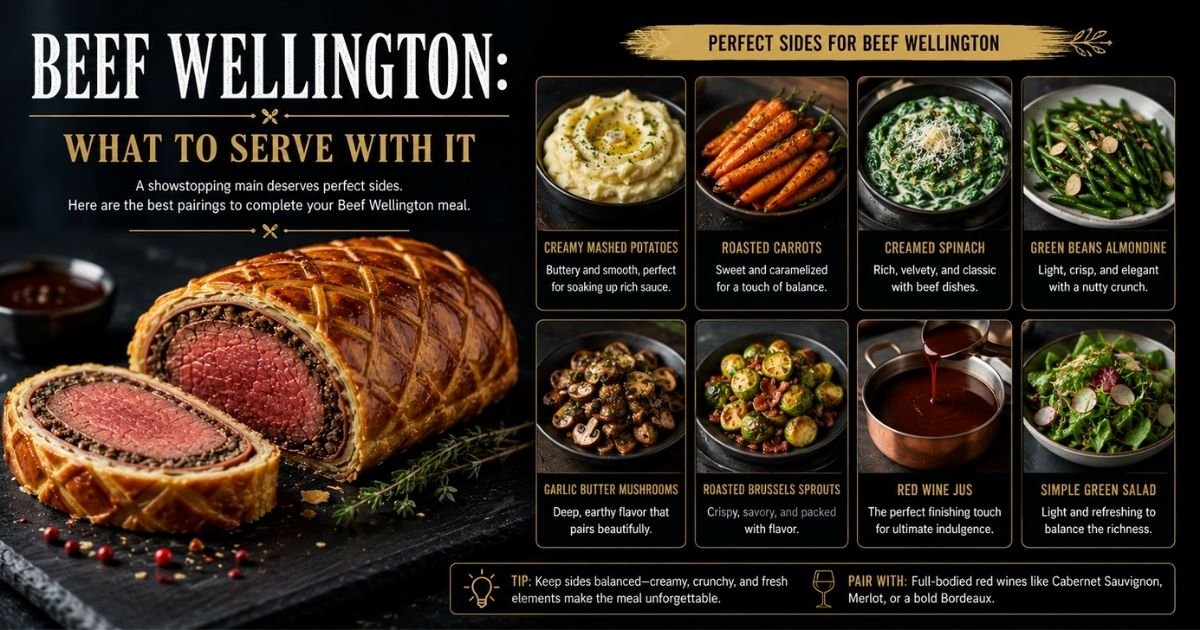
Beef Wellington: What to Serve With It
Beef Wellington is a balancing act on a plate. You have a whole tenderloin wrapped in mushroom duxelles, prosciutto and puff pastry, which means the main course already brings richness, salt and butter in large amounts. The sides have one job: add contrast without competing. A light green vegetable, a straightforward potato and a thin sauce served on the side will do more for the dish than anything elaborate.
Sides That Work, and Why
| Side | Why it works | Serve it |
|---|---|---|
| Fondant potatoes | Rich enough for the occasion, plain enough not to fight the pastry | Alongside the slice |
| Dauphinoise potatoes | Creamy and indulgent, best for a special occasion menu | In a small dish, not under the Wellington |
| Buttered asparagus or green beans | Colour and freshness against all that brown and gold | Across the plate |
| Roasted carrots | Sweetness that cuts through the duxelles | Scattered, not piled |
| Simple green salad with sharp vinaigrette | Acidity to reset the palate | As a starter, before the main |
The pattern is consistent. Potato carries the richness, green vegetables bring freshness, and anything sharp or acidic stops the plate feeling heavy. Pick one from each group and you have a complete plate.
Sauces: What to Pour, and Where
Red wine jus is the traditional choice. Pour it around the slice, never over it, because liquid on the pastry turns the crisp layers soggy within minutes. A peppercorn sauce works for the same reason the mushroom duxelles is already in the dish, it echoes the flavours without adding a new one. A thin mushroom sauce made from the same mushrooms as the duxelles is the most coherent pairing of all.
What the plate does not need is a heavy cream based sauce. The pastry and tenderloin already supply the richness, so a lighter, more concentrated sauce balances things better than something that coats the palate further.
Oven, Temperatures and Timings
The sides are only half the timing problem. A Wellington needs to rest for 15 to 20 minutes after leaving the oven, which is actually a gift, because it gives you a fixed window to finish everything else. Plan your sides to come out of the oven or off the hob just as the resting time ends, so nothing sits and cools while you wait.
For the Wellington itself, most recipes land around 200°C, or 180°C with a fan oven, for 25 to 35 minutes depending on the size of the fillet. Aim for an internal temperature of about 52°C for rare to 55°C for medium rare at the centre, remembering the temperature will rise a few degrees while it rests. A probe thermometer is the difference between guessing and knowing.
Slice with a sharp serrated knife in slow, single strokes rather than sawing back and forth. Sawing drags the layers apart and you lose the clean cross section that makes the dish look the way it should.
What Not to Put on the Plate
Skip anything else wrapped in pastry. A vol au vent or a pie alongside a Wellington is pastry competing with pastry, and the plate ends up monotonous. Skip very rich, cream soaked sides for the same reason, and keep strong flavours like blue cheese or heavy garlic away from the main course, since they will drown out the duxelles completely.
A Full Dinner Plan That Works
For a classic dinner party, start with the green salad and vinaigrette while the Wellington rests, then serve the sliced Wellington with fondant potatoes, buttered asparagus and red wine jus poured around the plate. It covers every base, freshness, richness, colour and sauce, without a single element fighting another. If you want the lighter version, swap the fondant potatoes for steamed green beans and use the thin mushroom sauce instead of the jus.
Dauphinoise potatoes can be assembled a day ahead and reheated, and both the jus and the mushroom sauce can be made the day before and warmed gently while the Wellington rests. That leaves only the green vegetables to cook on the night.
Eating Beef Wellington Out Instead
Plenty of steakhouses serve a Wellington as a seasonal or special occasion dish rather than a permanent menu item. Menus change with the seasons, so check the current menu directly, for example at Miller and Carter, before booking a table specifically for it.
If you want more detail on the cut the whole dish is built around, see tenderloin, frying steak and other cuts explained. Keep the sides simple, the sauce on the side of the plate, and the vegetables bright, and the Wellington does the rest itself.