
How to Cook a Well Done Steak
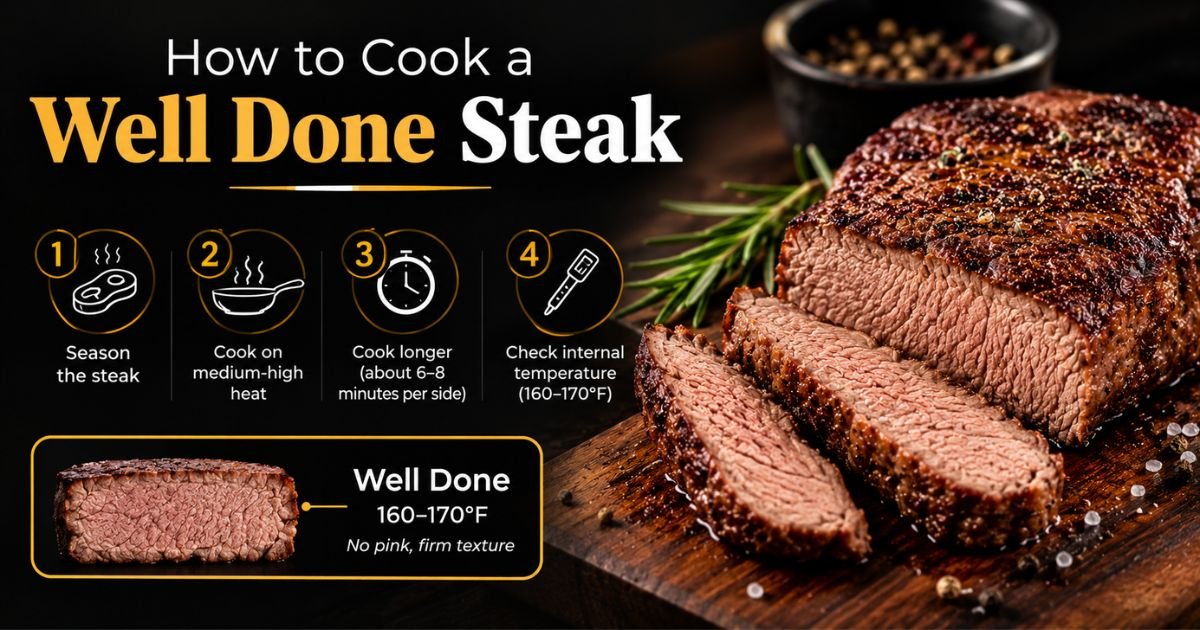
How to Cook a Well Done Steak
Cooking a well done steak that stays juicy comes down to one habit most home cooks get wrong. Sear hot for the crust, then drop the heat and finish gently. Blast it on high the whole way through and you get exactly what you feared: grey, tough, dry meat. The fix is simple, and it starts with internal temperature rather than guesswork.
The direct answer: sear your steak on high heat for the crust, then lower the heat to medium and cook until a meat thermometer reads 68°C. Pull it there, rest it five to ten minutes, and it will rise to about 71°C, which is a true well done. Below is the full method for pan, oven, and grill, plus the mistakes that dry a well done steak out fastest.
What Well Done Means in Degrees
Well done is not “cooked for a long time”. It is a specific internal temperature.
| Doneness | Pull Temperature | After Resting |
|---|---|---|
| Medium well | 63°C | 66°C |
| Well done | 68°C | 71°C |
Anything past 71°C loses moisture fast. There is no flavour benefit to going higher, only toughness.
Pick a Cut With Enough Fat
Not every cut survives this temperature. Fat is what keeps the meat from drying out during a longer cook.
- Ribeye: high fat content, forgiving even past medium.
- Sirloin: leaner but still workable at well done.
- Skip fillet: too lean, dries out fast at this temperature.
If you only have a lean cut on hand, a butter baste in the last few minutes helps replace some of the moisture the longer cook drives out.
The Pan Method That Keeps It Juicy
- Pat the steak dry and season with salt and pepper.
- Heat a heavy pan on high until it is just smoking.
- Sear 2 to 3 minutes per side to build the crust.
- Drop the heat to medium. Keep flipping every 2 minutes so no one side overcooks.
- Cook until the thermometer reads 68°C, roughly 10 to 15 minutes total depending on thickness.
- In the last few minutes, add butter, garlic, and thyme, and spoon the melted butter over the steak.
- Rest 5 to 10 minutes before cutting.
That heat drop in step 4 is the part most recipes skip. Staying on high the whole time chars the outside long before the centre catches up, which is the classic well done failure.
Oven Finish for Steaks Over 4cm Thick
- Sear 2 minutes per side in an oven safe pan on the hob.
- Move the pan to an oven preheated to 190°C, or 170°C with the fan on.
- Cook until the internal temperature hits 68°C, checking every few minutes.
- Rest before slicing.
The oven gives even heat all round, so you are less likely to overcook the outside while chasing a higher internal temperature.
On the Grill: Use Two Heat Zones
- Sear over direct high heat for 3 to 4 minutes per side.
- Move to indirect heat to finish cooking through without burning the crust.
- Check the temperature often. Well done steaks need more total grill time than medium ones.
- Rest 5 to 10 minutes off the heat.
No Thermometer? Use Your Thumb
Press your fingertips together firmly, then feel the base of your thumb. That firm resistance is close to what a well done steak feels like when pressed. It is not as accurate as a thermometer, so treat it as a backup, not your main method.
The Four Mistakes That Dry It Out
- Staying on high heat the entire cook, which chars the outside before the centre is done.
- Skipping the rest, which lets all the juice escape the moment you cut in.
- Using a very lean cut with no added fat or butter to compensate.
- Pressing down with a spatula, which squeezes out moisture you cannot get back.
Resting, Slicing, and a Sauce That Helps
Rest your steak for 5 to 10 minutes before cutting. This lets the juices redistribute instead of running out onto the board. A sauce with some richness, like peppercorn or garlic butter, also helps replace moisture that the well done cook naturally removes. If you want a benchmark for how the professionals build a plate, the Miller and Carter menu is a useful reference.
Well done does not have to mean dry. Sear hot for the crust, finish on medium heat, pull at 68°C, rest it, and add butter or sauce. Try it this way once and the difference the heat drop makes is hard to miss.